Tuesday, 17 July 2007

Indoor Plants are back

It's time to bring the dirt inside as indoor plants become the latest retro fashion.

Looking for something to add a little dramatic punch to your interior? Try a houseplant. Don't cringe. They may have been responsible for half the decorating crimes of the 1970s but they're back.

Recently, clean-lined interiors have been matched with architectural plants - hence the popularity of succulents such as agave and mother-in-law's tongue and strappy plants such as cordyline.

The key is don't go for something small. Having one strong plant can work really well as a focal point. Think of it as an indoor piece of artwork.

The best way to use indoor plants is by keeping it simple and, if you are using more than one plant, use just one species. Too much variety looks messy and doesnt suit modern architecture.

Saturday, 7 July 2007

Arctotis


Want some winter colour in your garden, here is a hardy dry tolerant plant that flowers through the winter. It is a groundcover to about 30cm tall and spreading to about 1m. Its silvery foliage is great for contrasting with other plants. Most commonly available varieties have yellow or orange flowers, which are long lasting, but you can get various shades of pink or white. Can be grown in the ground or a pot, they can look untidy at times, but a bit of a prune can usually fix that. A very hardy plant and one to consider if your looking for a groundcover.

Thursday, 5 July 2007

save the engine

A helpful hint to keep your 2 stroke engines going longer.
If you are not using your 2 stroke engines on a regular basis is is a good idea to empty the fuel tank as over a period of time the fuel to oil ratio will change. For the same reason you shouldnt mix up a large drum of 2 stroke fuel to keep in your shed. You may think it saves time but it may cost you money as your engines will wear out faster.

Thursday, 28 June 2007

walking down the garden path

Paths in the garden get you from a to b but it is important when thinking about putting in a path that you consider what it might be used for.

Gravel paths can look good but if you have a deciduous tree over it they can be hard to keep looking nice. They are also noisey to walk on which tends to make people walk faster over. It is also much harder to push a wheelbarrow on and if soil preperation is not good weeds may be an issue.

Sawdust is a material that i think is great for paths, especially around veggie patches. It tends to pack down well suppressing weeds and making it easy to push that wheelbarrow and if you decide to change the layout of your veggie patch you can just dig it into the soil. It is also good for a meandering path that people can walk slowly along as it is not too hard under foot and is quiet.

Pavers are just about a category to themselves as there are so many different types available. I might do another post on them specifically but for now, pavers are a good hard wearing path, especially good for entrances and high traffic areas. They take abit more preparation than gravel or sawdust but i suggest you do the right preparation, especially if you have a large area to do. The last thing you want to do is have to relay it every year because it has moved or sunk. Pavers do give a nice clean look though.

Concrete is the last type i will mention for now but personally i would use pavers over concrete any day. When i say concrete i mean a continuous slab of concrete too not concrete pavers. Like pavers concrete is hard wearing and good if you have vehicles driving over them but if you decide in the future to alter the path at all it is hard to do and costly.

There are other factors to take into concideration when making a path these include: Underground services (which may need to be dug up or inspected)
Plants along the edge or adove (which may stain or litter the path as well as lift pavers or concrete)
amount of traffic
type of traffic (relating to width of path)

Keep it sharp

While the weather is a bit cold and wet outside, not that im complaining about the rain. This is the perfect time to be doing a bit of maintenance on all your garden tools. Keeping your tools maintained will make a big difference when you come to use them. sharpen shovels, mattocks, picks, axes and even crowbars along with your hand tools like sacateurs and hedge clippers. You will be surprised what a difference it makes.

The other thing to do is sand back any weathered or splintering timber handles and apply linseed oil with a rag. This will stop the timber drying out and splintering in summer.

Thursday, 21 June 2007

genus species?

If your into gardening fairly well this information probably wont be new to you but just for those interested, plants have two different types of names botanical and common.

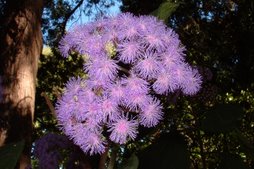
Common names are names that are given to plants in terms that people can commonly understand and usually have something to do with the appearance of the plant like Floss Flower like in the picture or ghost gum because of its pale colured bark. The problem with common names is anyone can make them up and the same name can be used to describe several different plants.

Botanical names on the other hand can only be used once and have to be registered. All plants will have two names eg Ageratum houstonianum which is the genus (Ageratum) and species (houstonianum). There is actually i think 5 names in the botanical naming of things but 2 are the more specific and anyway two are hard enough to say without having to try and say five. If anyone wants me to go into naming more feel free to ask.

Chances are if you only see one name it is the genus which is less discriptive than the species and is a group of similar plants eg eucalypt and grevillea are both types of genus and is being used because the species is unknown, hence in the photo it is only ageratum as i am not sure of the species, it is however most likely a houstonianum cultivar. Cultivars and hybrids we can get into another day.

If you can have both a common name and a botanical name when you go the the nursery to buy plants thats fantastic, or alternativley bring in a piece of the plant, being able to see it is easier for identification than trying to figure it out from a description.

Dam internet

As i mentioned before i work in retail, in a nursery of course and as i mentioned before i might winge once in a while, well im starting already.

Today i had a customer ring up and ask me why we were selling tahitian limes because he had bought one from the store and had it for a couple of years and it hadnt done any good so he went on the internet and apparently found a site that said tahitian limes dont grow in Australia. Now as i told the customer that is the most rediculuous comment to make. What a huge generalisation considering the wide range of conditions we have in australia from tropical to arid and everything inbetween. This is the problem with the internet, anyone can get on here and make comments like that which then makes it difficult for the people who have to deal with the problem.

My advise to people would be talk to your local nursery staff thay may not know it all but they have a better knowledge of your area than some random website that could be from anywhere in the world.

For those that are interested tahitian limes do grow fairly well across adelaide (keeping in mind we have a variety of conditions even in adelaide ie beach front, hills etc.) and have a larger fruit than the west indian lime.

The problem with the customers lime was that he had planted it in a heavy clay soil which is not good for most plants without some soil preparation. As i told him if you are planting into heavy clay it is best to add compost and gypsum to the soil and build a motte around the plant with soil so you can fill it with water as clay soils take longer to adsorb water.

If anyone has any problem with what i write here interms of plant information feel free to drop me a line as i would hate to cause someone else the same problem.